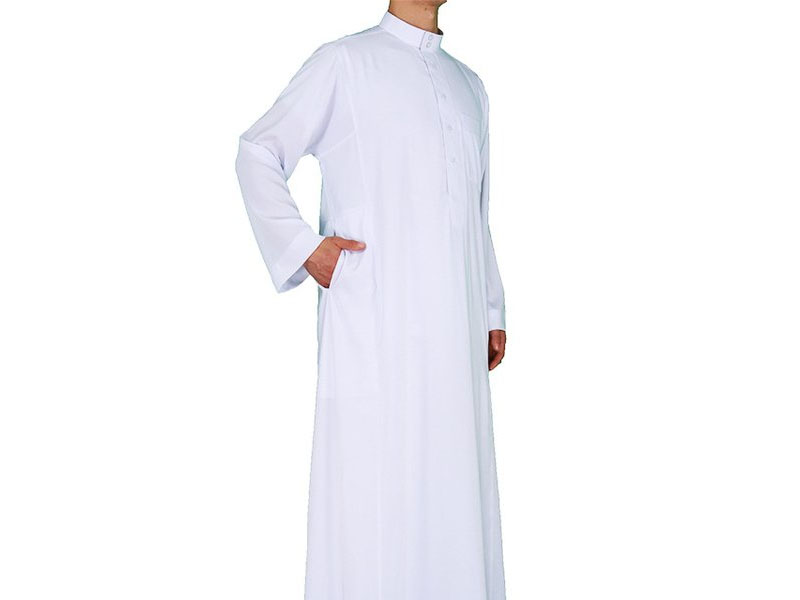
Arabian robes fabric is a professional high-grade textile material exclusively developed for Middle Eastern traditional long robes, also known as thobe, kandura and abaya garments. Centering on high-count solid-color bleached and dyed filament fabric, this material is customized according to the local climate characteristics, traditional dressing habits and religious etiquette of the Middle East region. Unlike ordinary costume fabrics that pursue diverse patterns and thick texture, Arabian robes fabrics focus on pure color simplicity, smooth delicate touch, lightweight drape and extreme climate adaptability. It has become the standard and most popular special fabric for mass production and personalized customization of Middle Eastern long robes, fully meeting the daily wearing, religious ritual and formal occasion dressing needs of Middle Eastern residents.
The core feature of Arabian robes fabric lies in its high-count filament weaving technology and pure-color finishing process, which shapes the unique wearing temperament of traditional Middle Eastern garments. Adopting fine high-count long丝 fibers, the fabric boasts a tight, uniform and smooth weave structure with ultra-fine surface texture, no coarse particles or bulky feel. High-quality bleached filament fabric presents a pure and flawless milky white tone, with soft natural luster and clean and elegant visual effect, which is highly in line with the solemn, simple and generous dressing aesthetics of Middle Eastern traditional robes. On the basis of stable filament base cloth, solid-color dyed fabric provides rich and restrained color options such as classic black, navy blue, gray and khaki. Through precise environmental dyeing technology, the color is uniform and full, without color difference or floating color, maintaining a low-key and high-grade texture for a long time, and perfectly adapting to the formal and solemn attribute of traditional Arabian robes.
In terms of functional performance, this high-count bleached and dyed filament fabric is highly adapted to the typical high-temperature and dry desert climate of the Middle East, with outstanding breathable cooling and comfortable wearing advantages. The lightweight fiber structure greatly reduces the sense of restraint of long robes, realizing zero-burden wearing. The excellent air permeability and vertical heat dissipation performance can quickly discharge body heat, effectively resisting the sultry feeling caused by long-term outdoor high temperature, and keeping the body dry and cool throughout the day. Compared with ordinary thick fabrics, high-count filament fabric is not easy to stick to the skin after sweating, ensuring flexible limb movement and comfortable wearing experience during daily work, outdoor activities and religious worship. In addition, the fabric has excellent dimensional stability and color fastness, resisting long-term sun exposure, frequent washing and daily friction. It does not fade, yellow, shrink or deform, always maintaining a flat, straight and drapey garment shape, and solving the problems of easy wrinkling and poor shaping of traditional robe fabrics.
In terms of application scenarios, Arabian robes filament fabric is highly targeted at the exclusive customization of Middle Eastern traditional long robes, covering men’s thobe, kandura, women’s abaya and various ethnic custom long garments. The pure white bleached fabric is widely used in formal worship costumes, festival costumes and high-end ceremonial robes, highlighting solemnity and holiness. The solid-color dyed fabric is more suitable for daily casual wearing, business commuting and social occasion robes, with versatile and inclusive styles. With exquisite texture, superior climate adaptability, stable shaping effect and long-lasting wear resistance, this high-count solid-color filament fabric has become the core mainstream material in the Middle Eastern ethnic garment market, perfectly interpreting the integration of traditional ethnic dressing culture and modern comfortable textile technology. (Word count: 1001)